At NeuronicWorks, we stand ready to partner with you through every phase of this complex lifecycle, turning your most ambitious designs into manufacturing successes.
Navigating the Path to Production: A Guide to Scaling Manufacturing
Bringing a new product to market is a journey that requires more than just a great design. To move from a successful prototype to repeatable, high-quality commercial production, companies must navigate a complex post-design landscape of verification, optimization, manufacturing and supply chain management.
At NeuronicWorks, we often emphasize that scaling isn't just about making “more” of something; it’s about ensuring that the thousandth unit is as reliable as the first. Before a product is ready for the assembly line, it must move through a rigorous process of testing and refinement. While our previous deep dive into electronic product development covers the initial stages of turning an idea into a functional prototype, this blog post focuses on preparing to scale for manufacturing.
Verification vs. Validation: Building it Right vs. Building the Right Thing
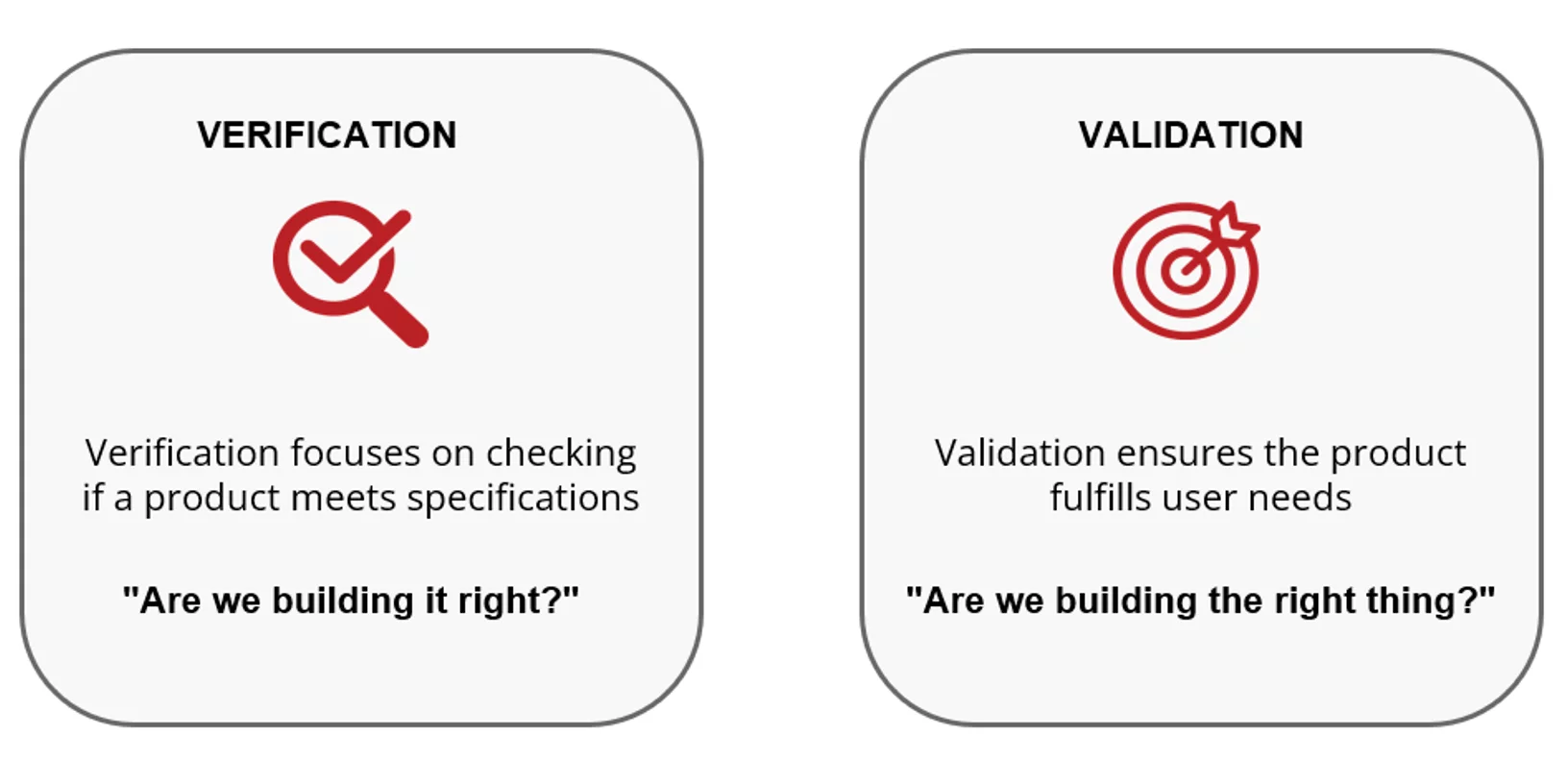
The foundation of successful scaling lies in understanding two key concepts: verification and validation.
- Verification focuses on the technical question, “Are we building it right?” It confirms that the product meets its defined technical requirements. To verify this, the engineering team that develops the product runs a series of tests to assess performance, compliance with applicable standards, reliability, and, where needed, ruggedness.
- Validation asks the human-centric question: “Are we building the right thing?”. This ensures the final product actually fulfills the user's needs and intended use. Validation is done usually by the product owner and ultimately by the market itself.
The Roadmap to Production
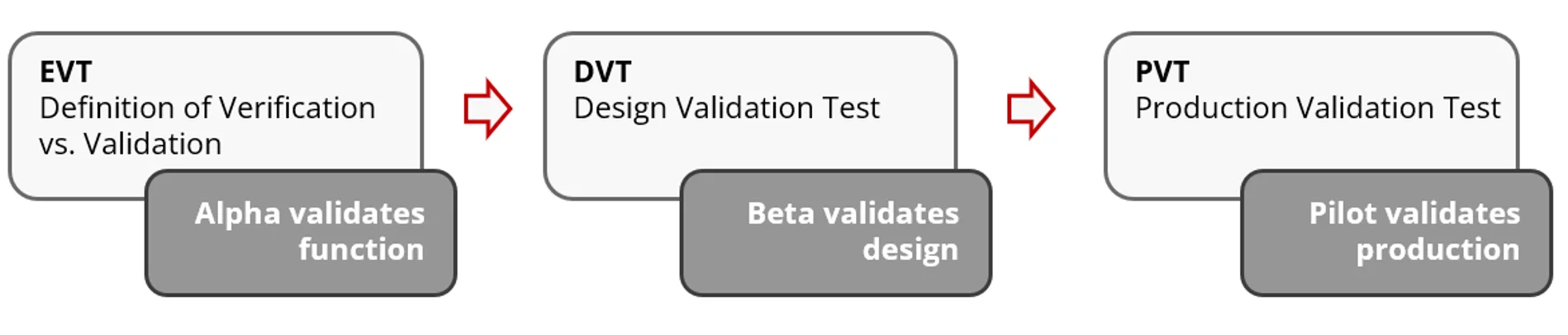
The transition from a laboratory concept to a consumer-ready product is often referred to as the “Roadmap to Production.” This isn't a single jump, but a series of incremental, high-stakes gated process designed to catch errors early and optimize the manufacturing process. By breaking the roadmap down into Alpha, Beta, and Pilot stages, also known as EVT, DVT, and PVT, companies can systematically eliminate risks before committing to expensive high-volume runs.
The product development process typically follows three critical testing and validation stages:
| Stage | Primary Focus | Goal | |
|---|---|---|---|
| Alpha | EVT: Engineering Validation Test | Core Functionality | Does the “math” work in physical form? |
| Beta | DVT: Design Validation Test | Product Integrity | Is it durable, compliant, and “final”? |
| Pilot | PVT: Production Validation Test | Process Reliability | Can the factory build it fast and reliably? |
Rigorous Prototype Verification
Before a single unit is manufactured and shipped to a customer, the final prototype must undergo verification. While a prototype might work perfectly on an engineer's workbench, it must be proven to survive the rigors of shipping, extreme weather exposure, and years of daily use. This stage is about finding the “breaking point” of the product so it can be reinforced, if needed, before it reaches the market. This includes:
- Functional Testing: Verifying performance against the Requirements Traceability Matrix (RTM).
- Environmental & Reliability Testing: Stressing the product through drop testing, shock and vibration, thermal cycling, salt spray testing and humidity (IP rating) tests
- Lifecycle Evaluation: Using Accelerated Life Testing (ALT) to quantify expected lifespan and Highly Accelerated Life Testing (HALT) to find the product's ultimate limits.
- Compliance: Ensuring the product meets safety and regulatory standards, including UL/CSA, HIPOT, ESD, EMI/EMC, RoHS/REACH, PTCRB and FCC/CE marking.
The above list covers some of the most used type of tests, but based on the product type and intended market, the tests and verification required can be more specific and targeted.
Optimization for Production Readiness
Transitioning to manufacturing means also evolving the design to suit the capabilities of the assembly line. A design that is easy for an engineer to assemble by hand may be impossible for a machine to build at high speed. This phase, often called Design for Manufacturing (DFM), is where the product is refined to reduce costs, minimize assembly errors, and increase throughput.
As mentioned in detail in our blog on Design for Excellence, DFM is not a final “checkbox” step; it must be integrated early in the development cycle through a holistic lens. This requires deep collaboration between all stakeholders, from product owners, designers, engineers and system architects to regulatory houses, component suppliers, and contract manufacturers. By involving the certification and manufacturing partners early in the development process, you ensure the design is optimized from every angle. Key optimization steps include:
- BOM and Material Optimization: Refining the Bill of Materials and selecting materials that support volume production.
- Tolerance Refinement: Ensuring parts can be assembled consistently within manufacturing tolerances.
- Assembly process planning: Defining clear work instructions, tooling, and test steps for repeatable high-volume assembly.
- Design for Automation: Identifying sub-processes that can be automated to increase efficiency, consistency, and cost-effectiveness.
Building a Robust Supply Chain
In today's global market, scaling manufacturing is as much about logistics and partnerships as it is about engineering. A brilliant product is worthless if you cannot source the components to build it or if your manufacturing partner cannot meet your quality standards. A robust supply chain strategy focuses on creating resilience, transparency, and clear communication with every vendor in the chain. A clear strategy must be developed for both materials and manufacturing partners:
- Material Supply Chain: Moving beyond prototype vendors to establish dedicated relationships, plan lead times, and coordinate inventory.
- Manufacturing Partners: Identifying capable vendors for assemblies or subsystems and assessing their capacity and operational risks.
- Collaborative DFM: Establishing direct communication with Contract Manufacturers (CMs) to adapt the design to their specific internal Design for Manufacturing (DFM) guidelines.
The journey from a functional prototype to a successful commercial launch is rarely a straight line; it is a meticulous process of iteration, verification, and strategic planning. As we have explored, scaling manufacturing is not just about increasing quantity, but about maintaining the integrity and reliability of your design across thousands of units. By adhering to a structured roadmap, from the functional focus of Alpha (EVT) to the production-ready rigor of Pilot (PVT), companies can bridge the gap between “it works in the lab” and “it works in the real world”.
All Blogs